The Responsible Business Alliance (RBA) claims to set leading standards for onsite compliant audits. Yet, its member companies keep failing to prevent serious labor risks, and the RBA continues to ignore China Labor Watch’s (CLW) request for increased transparency.
Since January 2024, CLW and nine other civil society groups have been actively engaging the RBA on the disconnect between their audit findings and the reality on the ground for workers. While we have called on the RBA to introduce transparency in its auditing process, the current issues today reflect that nothing has changed.
Beyond Audit Checklists: Real-World Consequences
Recently, the RBA’s Validated Assessment Program (VAP) was publicly credited for ‘passing’ multiple “Foxconn manufacturing sites in China”, suggesting these sites reflect “a commitment to critical compliance and transparency in social and environmental responsibility”.
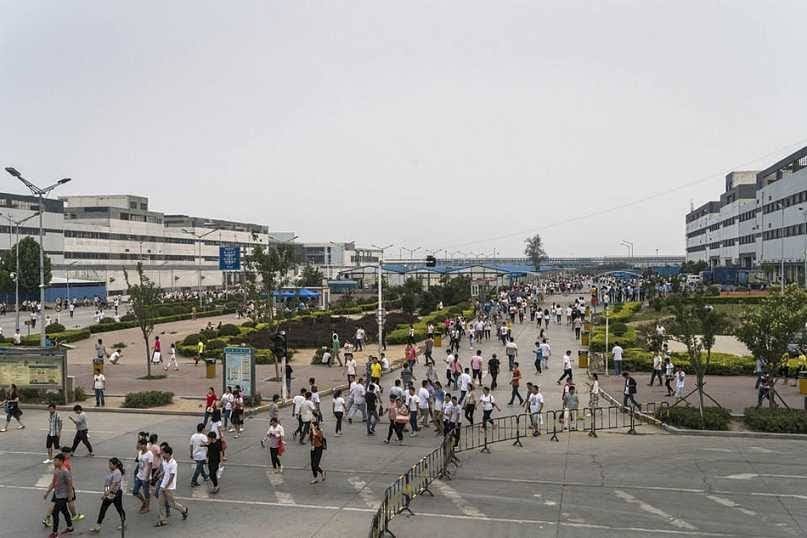
Shortly after, workers at a Foxconn manufacturing site in Zhengzhou, China, reported a very different reality while assembling the new iPhone 17: overtime and working hours over the legal limit, withheld wages, and recruitment discrimination. A journalist from the Financial Times also interviewed workers from Foxconn Zhengzhou and reported on their findings. As a factory with an estimated 200,000 workers, Foxconn Zhengzhou is one of the largest electronics factory in the world.
When CLW repeatedly requested the RBA to disclose minimal, non-sensitive details such as factory locations, audit dates, or assessment ratings of each factory it has audited, we did not receive a response. The RBA’s continued silence on this is both concerning and revealing. It blocks independent scrutiny precisely when credible evidence of violations exists. Yet, the silence is not new.
If labor risks continue to exist in the factories that recently ‘passed’ RBA’s VAP audit, it suggests critical gaps. For one, the VAP audit process either failed to detect fundamental violations. Second, potential systemic weaknesses may exist in RBA’s methodology such as pre-announced visits, management-selected interviewees, document-based checks, or conflict-of-interest pressures. All of this can inadvertently sanitize findings.
A recurring problem
Foxconn Zhengzhou is only one example. Similar patterns have been documented across other RBA-member suppliers, such as:
-
- Pegatron. In 2023, we found that Pegatron Kunshan, during the production of the iPhone 15, exceeded the legal limit on the number of dispatch and hourly workers allowed to work at the factory, as well as overtime hours (84-97 hours per month on average per worker, exceeding the 36 hour per month by law), amongst other labor issues.
- Compal Electronics. We reviewed the social media posts of workers at Compal Electronics between 2018-2023, and workers described issues such as wage theft, discrimination, workplace bullying, deception, and poor living conditions.
- Quanta Computer. In the production of electronics for Dell, workers reported wage arrears, poor living conditions, workplace bullying, and mandatory overtime.
These recurring patterns across different factories, regions, and member companies demonstrate that the limitations are structural, not incidental. If the RBA’s assessment programs cannot identify coercive conditions already well-documented by independent organizations, it calls into question the credibility of industry-led due diligence. Social audits, as currently structured, risk serving as liability shields rather than accountability tools. The lack of response on RBA’s end and its ensuing silence is deafeningly loud.
Most importantly, the (in)effectiveness of the VAP cannot obscure the fundamental point that audit failures translate directly into human consequences. Workers at Foxconn Zhengzhou, Pegatron Kunshan, and many others experience these consequences not as theoretical compliance gaps, but as lived violations. Until accountability mechanisms move beyond self-reporting and reputational compliance, forced labor indicators will continue to recur under different guises.
Undermining responsibility
The RBA’s failure to identify serious labor violations also undermines honest companies that invest time and resources to comply with labor standards. When factories with ongoing abuses are certified as “compliant,” it creates a race to the bottom, where cutting corners carries no penalty and doing the right thing yields no reward.
By giving a free pass to factories that flout labor standards, the RBA sends the wrong message: that compliance is optional, and that ethics are just a branding exercise.
The result is a credibility gap that punishes good-faith efforts and rewards opacity. Companies genuinely trying to improve conditions for workers are left competing with suppliers who can simply pass an audit on paper. In the long term, this erodes trust in the entire due-diligence system and discourages responsible business behavior.
Calls to Action
We repeat our call to the RBA to urgently:
-
- Disclose the names, locations, audit dates and ratings of all Foxconn factories audited under the VAP,
- Confirm whether the dispatch workers, student workers, and hourly workers were included in the audit interviews, and
- Provide a formal response to our prior letter and to the findings outlined in this investigation.
We call on policymakers and authorities to:
-
- Reject social-audit certifications as sufficient proof of corporate due diligence,
- Mandate companies to undertake human rights and environmental risks-based due diligence, bearing in mind the point above, and
- Subject audit schemes to regulatory and judicial scrutiny to ensure they generate credible, site-specific information on human-rights risks.
Update: Foxconn has published the results of its Validated Assessment Program under RBA. Please see the results below: