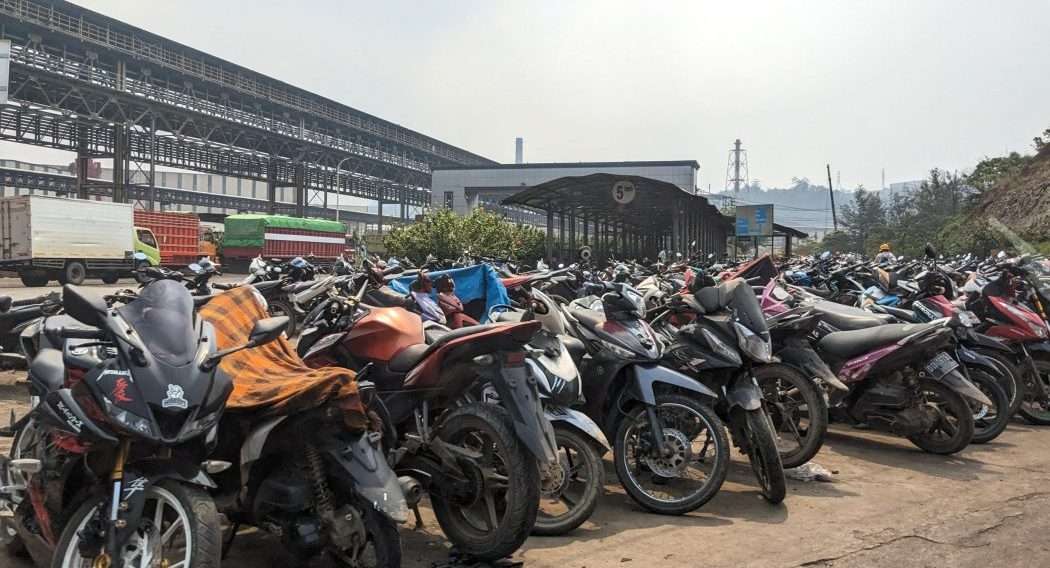
Operational challenges, protests, and nickel prices drop have disrupted production at multiple Chinese-run nickel processing plants in Indonesia. These, together with global uncertainties and a constricting global regulatory landscape, overshadow the sector’s growth prospect and affect the livelihood of thousands of those working in nickel plants. Below are some recent developments at select Chinese plants.
PT IMIP
As Ramadan approaches, organized and spontaneous protests erupted in different parts of Indonesia. At Indonesia Morowali Industrial Park (IMIP), Indonesia’s largest nickel processing industrial park located in Morowali Regency, Central Sulawesi, trade unions and civil society groups have staged multiple protests and rallies throughout February. Some of these events are detailed below.
On February 18, the Morowali Mining and Energy Industry Workers Union (SBIPE) staged a demonstration in front of the PT. IMIP office, demanding that the plant take responsibility for three workplace accidents in February 2024, which led to multiple worker fatalities and cases of permanent disability.
The Union demanded the plant to compensate the victims of recent incidents and improve workplace health and safety training, and ensure proper provision of Personal Protective Equipment (PPE). However, the demonstration was met with repression. According to local sources, the plant’s security forces used violence against protesters, including trampling an unidentified female worker.
A few days later, on February 22, hundreds of migrant Chinese workers gathered to demand unpaid wages from PT QMB New Energy Materials (PT QMB), a facility in IMIP. The affected workers were primarily construction workers employed by Jiulong Labor Service, an outsourcing unit contracted by PT QMB.
PT QMB is a joint venture of multiple industry giants, GEM Co., Ltd, Tsingshan Group, Guangdong Bangpu Cycle Technology Co.,Ltd – a subsidiary of car battery producer CATL– and new energy companies EcoPro and Hanwa Group. PT QMB specializes in green energy products and is a key project under Belt and Road Initiative to strengthen China’s position in the global green energy supply chain.
The protesting workers primarily worked in construction. They typically work six consecutive months without rest days, and are not allowed to leave the park without permission – conditions that strongly indicate forced labor. These incidents further highlight structural issues in IMIP’s labor management.
PT GNI
PT Gunbuster Nickel Industry (PT GNI), a US$3 billion nickel processing company operating in North Morowali, Central Sulawesi, faces potential shutdown, risking the livelihood of over 10,000 Indonesian workers and over 1,000 foreign workers it employs.
According to Bloomberg, PT GNI is delaying payment to local nickel suppliers, causing supply disruptions. In response, the plant has cut nickel production significantly. According to local informants, multiple production lines have ceased operations, and many migrant Chinese workers have been sent home.
GNI’s production slash has been associated with multiple factors. Last October, its parent company Jiangsu Delong Nickel Industry Co. declared bankruptcy, due for a debt restructuring. This has affected its wholly owned subsidiary, GNI’s finances.
In addition to the parent company’s bankruptcy, the global nickel prices have dropped since the end of 2022, contributing to the plant’s financial woes. Analysts pointed out that GNI’s troubles, on a general level, reflect intense competition in Indonesia’s nickel industry due to the industry’s rapid expansion in recent years.
Indonesia has implemented strong downstreaming policies restricting raw nickel ore export while incentivizing foreign investments in nickel processing facilities, boosting the sector’s explosive growth. GNI was a benefactor of Jakarta’s industrial policy. The 7th President of the Republic of Indonesia Joko Widodo (Jokowi) inaugurated PT GNI on December 27, 2021. PT GNI is also included in Indonesia’s National Strategic Project (PSN).
However, the rapid increase of nickel investment has led to increased operating costs and a decrease in the price of ferronickel products. The nickel plants invested by Jiangsu Delong – PT GNI, PT Virtue Dragon Nickel Industry (VDNI), and PT Obsidian Stainless Steel (OSS) – contributed an estimated annual net loss of 1.8-2.2 billion yuan.
PT VDNI
Located in Morowali Regency, Central Sulawesi near PT IMIP, PT Virtue Dragon Nickel Industry (VDNI), also faced increased protests gathered around the facility in recent weeks.
Protesters, organized by different trade unions and civil society groups, rallied near the plants on different dates. They are nonetheless united by shared demands: They called for VDNI to improve health and safety standards and increase wage standards.
While protesters gathered outside of the facility, Chinese migrant workers within the plant were gathered to defend the facility. Coinciding with the date of a local trade union, KAPN’s protest, for example, a few videos became widely distributed on social media sites, such as Instagram and Tiktok, depicting a group of Chinese foreign workers wearing yellow uniforms and helmets and carrying iron bars. This sparked concern among residents, with many raising concern over local workers’ safety and calling for stricter supervision of foreign workers.
A similar event occurred in January 2023, when a massive protest erupted in PT GNI. According to local informants, Chinese workers were equipped with iron bars and helmets to protect the facility under their management’s demand. Many were also told that the protest was a “riot” led by anti-Chinese sentiments, while language barriers prevented them from understanding Indonesian workers’ demands otherwise. The event ultimately evolved into a clash between the two ethnic groups, leading to two deaths. Among them was one Chinese worker and an Indonesian worker.
CLW cannot confirm whether the February incident is connected to management demand. Yet given precedents, we call for the public and Indonesia’s civil society to raise alert to employers’ practices that utilize ethnic frictions to divide the workforce and prevent the formation of broad-based solidarity.
All in all, an array of factors contributed to operational troubles of Chinese nickel plants in Indonesia, possibly leading to delayed payments, decreased safety standards, among other issues.
The nickel industry’s rapid expansion in recent years has led to concern over exhausting the country’s mineral reserves and destabilizing nickel’s market price. According to the Ministry of Energy and Mineral Resources’ records, as of the end of 2024, Indonesia will have 190 nickel processors, consisting of 54 smelters in operation and 120 that are in the construction stage, while 16 are in the planning stage.
Meanwhile, nickel production is estimated to reach an annual rate of 200,000 tons for the 54 smelters in operation. Indonesia’s total nickel reserve is measured to be around 5.3 billion tons. Under this rapid expansion, the authorities raised concerns over depleting nickel reserves. This, coupled with a drop in global nickel prices and constricting global regulatory landscape catalyzed a reassessment of investments in the field, leading to Jakarta’s plan to cut nickel production.
China’s heavy involvement in the sector has also drawn concern. China is a major player in Indonesia’s nickel supply chain, controlling 75% of Indonesian nickel capacity, according to Reuters. Given their significant market share, Chinese companies’ poorly monitored labor and environmental practices drew further scrutiny, leading to targeted protests and discourse surrounding these firms.
To improve Chinese companies’ image and operational environments overseas, CLW urges relevant stakeholders to review and reassess investment standards and conduct extensive need assessment prior to market entrance. During business operations, we call for companies to reassess and improve their environmental, labor standards to safeguard local communities’ wellbeing and, by extension, protect business image.


