Li Qiang, Executive Director of China Labor Watch
Testimony before the Congressional-Executive Commission on China
July 31, 2012
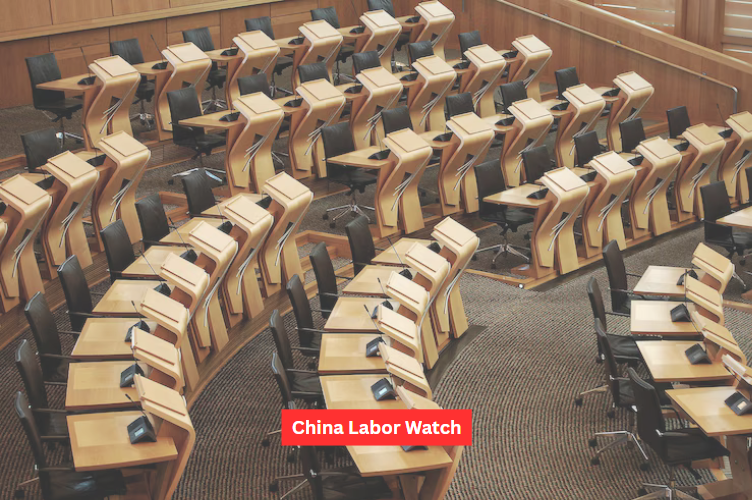
China Labor Watch’s executive director Li Qiang made a testimony in front of the Congressional-Executive Commission on China, drawing on his 20 years of experience advancing labor rights for Chinese workers. He began by recalling his previous testimony in 2000 during the debate over granting China permanent normal trade relations, emphasizing that trade cannot be separated from human rights and that worker rights must be part of trade initiatives.
Li Qiang highlighted three major issues in his testimony:
1. Harsh Labor Conditions in Chinese Factories
Li presented findings from a new China Labor Watch report on 10 Apple suppliers in China, noting that labor conditions remain extremely harsh 11 years after China joined the WTO. Common problems included:
- Excessive overtime, with workers often exceeding legal limits by working 100–180 hours of overtime per month.
- Long workdays (typically 11 hours), with minimal days off-even as little as one day per month during peak seasons.
- Low wages, forcing workers to accept long hours just to subsist.
- Dangerous working conditions, including exposure to hazardous materials.
- Poor food and overcrowded, unsanitary living conditions.
- Lack of awareness about unions and legal rights among mostly young female workers.
- Failure to provide legally required insurance in some factories.
He singled out the Riteng factory for particularly poor conditions, with nearly 12-hour workdays, extremely low wages, and widespread reports of unsafe and unhealthy environments.
Li also discussed the widespread use of “labor dispatching” (similar to temp agencies), which creates further problems for workers, such as lack of job security, denial of benefits, and excessive overtime. He noted that Apple’s social responsibility reports had largely ignored these issues, except for some improvements at Foxconn.
2. Flaws and Corruption in Corporate Auditing Systems
Li criticized the main response of multinational corporations-supplier auditing systems-as fundamentally flawed and often corrupt. He explained that:
- Audits are frequently ineffective, with little real improvement in labor conditions despite tens of thousands of audits each year.
- Corruption is rampant, with factories bribing auditors to receive passing marks at a fraction of the cost of actually improving conditions.
- China Labor Watch uncovered and reported several cases of audit corruption, leading to some positive changes, such as the dismissal of auditors and the revocation of certifications.
- He illustrated how audit corruption directly harms workers, citing specific cases where workers lost wages due to fraudulent audits.
3. The Need for Multinational Corporate Responsibility and Government Action
Li argued that real improvements in labor conditions are unlikely unless multinational corporations, such as Apple, use their influence and resources to demand better standards from their suppliers. He also called for the Chinese government to enforce its own labor laws more aggressively.
He concluded by emphasizing that, in the absence of independent labor unions in China, the responsibility falls on multinational corporations to act as responsible corporate citizens and for continued external pressure to drive change. He also noted that labor rights violations are not limited to Apple’s suppliers, but are common across factories supplying other major brands like HP, Dell, and Samsung, sometimes with even worse conditions than those found at Apple suppliers.
For full text, see https://www.govinfo.gov/content/pkg/CHRG-112jhrg76387/html/CHRG-112jhrg76387.htm